Panic at the PSX
Diving deep into the PSX 2026 bloodbath by analysing market physics, Persian armadas, and the panic paralysis.

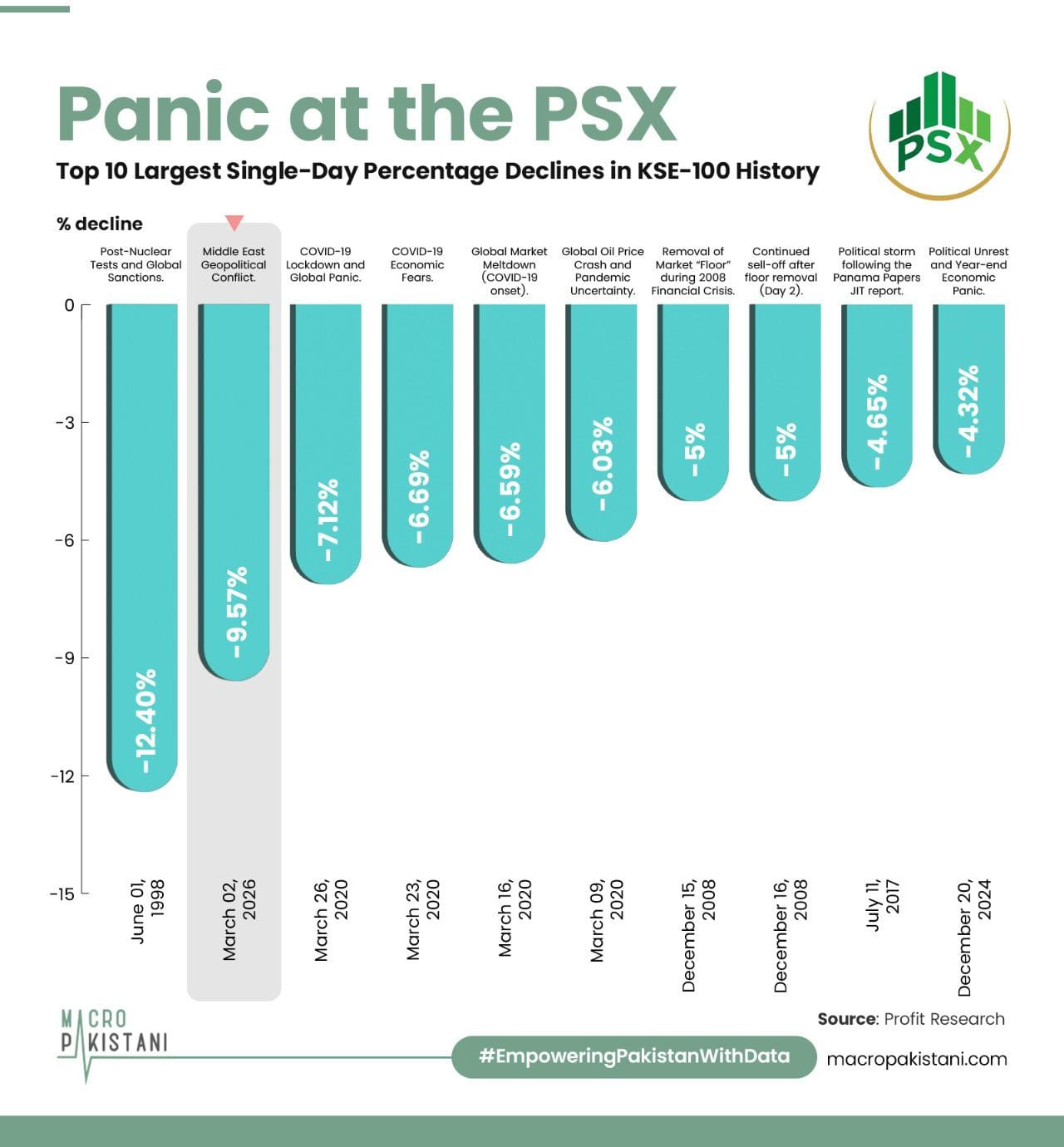
The KSE-100’s 16,000-point evaporation last week was supposed to be a market correction, but felt like a systemic mini heart attack (among many others during this week due to ongoing turbulence). While the US-Israel “pre-emptive” strikes on Iran provided the geopolitical spark, the resulting 9.57% plunge, the largest single-day absolute drop in history, exposes internal fragility. The bullish market narrative that has reigned since 2024’s highs was already weakened by the SBP’s hawkish interest rate hold at 10.5% and the FCC’s PKR 300 billion Super Tax judgment, but the final blow was provided by the Brent crude spike toward $82. But looking closer at the tape, one can see this as a classic case of a liquidity spiral. As blue chips like Meezan Bank and FFC buckled, the market’s internal mechanics, specifically the PKR 120+ billion in MTS leverage and mutual fund redemption pressures, caused a force liquidation spree.
Is the crash unprecedented, and if so, will the investor sentiment return?
The current crash sits in a dense historical cluster of mean-reverting corrections that typically bottom within two to six months. In short, the KSE-100 is currently undergoing a technical correction according to an analyst, not a fundamental collapse. While the -12.8% drop feels apocalyptic, historical data suggests this is a standard breather after a 378% bull run. Statistically, the market typically finds its floor within 2–6 months before a sharp recovery.
According to the structuralist analysis of Hanif (2022), unlike the 2005 crisis, which was a hollow bubble of Badla financing (a primitive precursor to MTS), the 2026 market is anchored by an average ROE of 25.2% (Shah et al., 2022), suggesting that the primary mechanism is one of liquidity, not solvency. The mechanics of this slide are driven by Asymmetric Risk Aversion; as Raza & Kemal (2017) postulated, the PSX reacts with “ferocious” speed to negative global news, triggering a mechanical Loss Spiral where PKR 120+ billion in MTS leverage acts as a high-octane accelerant.
In other words, when the market drops, investors who borrowed money via the Margin Trading System (MTS) see their collateral value evaporate. Because they only put up a fraction of the cost, leveraging PKR 120+ billion in debt, even a 10% dip can wipe out their entire equity. This triggers a loss spiral: brokers automatically dump the shares to recover their loans, which further depresses prices, triggering more margin calls for other investors. As the SBP’s hawkish pause pushed 12-month yields above the policy rate, a flight to safety ensued. The lower the price goes, the more margin calls are triggered, creating a self-fulfilling prophecy of destruction independent of corporate fundamentals. Statistically, the -20% threshold (152,826) remains the “Rubicon”; as long as the index stays above this level, the data from the last 19 seismic geopolitical episodes, from the Kargil War to the 2025 border friction, suggests that the market is merely charging a panic tax before an inevitable recovery.
Pakistan’s stock market dynamics have shifted radically, with a changing investor base, rising geopolitical and regional uncertainity and economic threats. Between corrections and shocks, the market has swung like a pendulum. Yet for the patient investor, the opportunity remains, provided they can keep their head while the algorithms lose theirs.
GRAPHIC
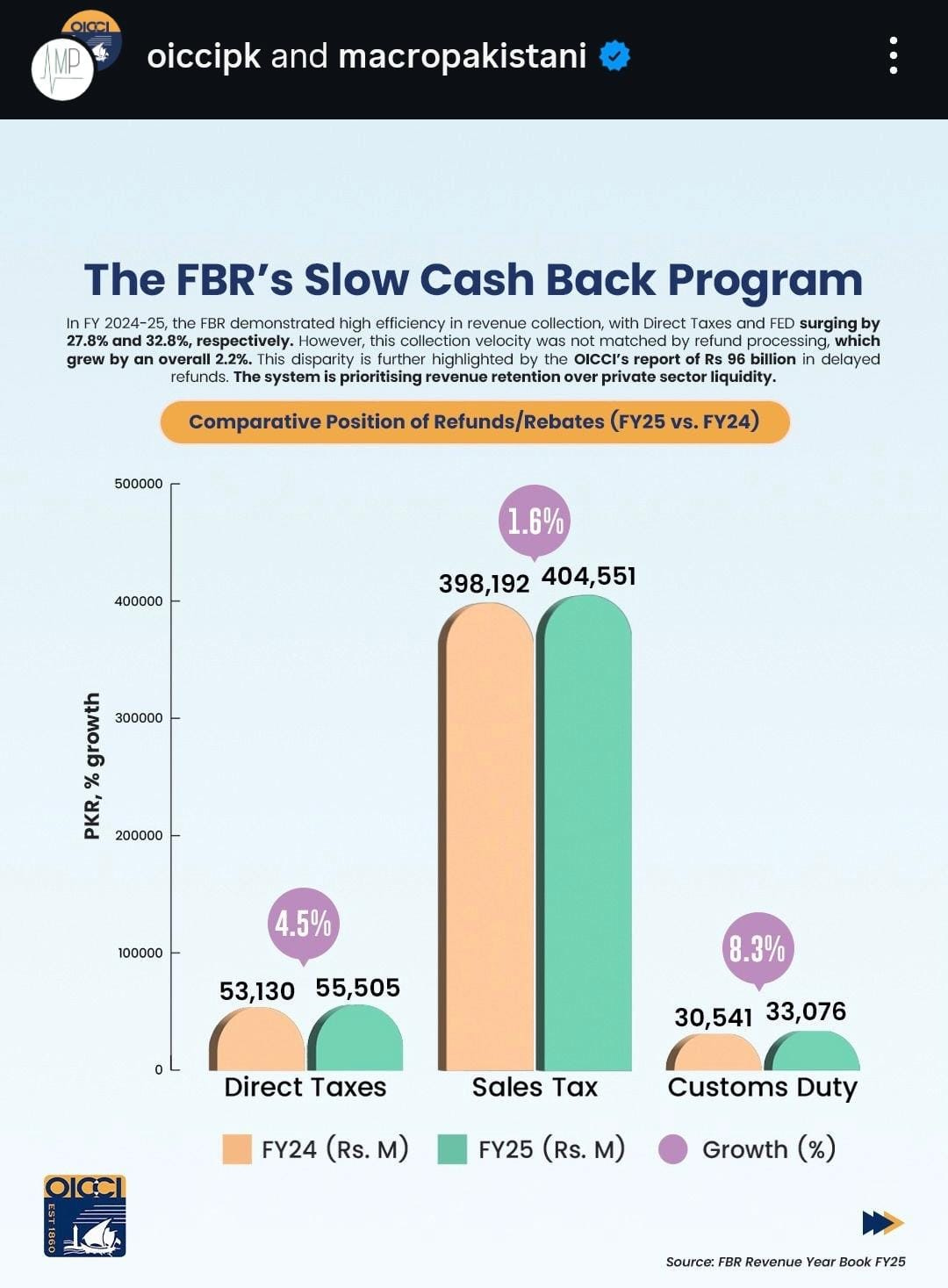
In FY 2024-25, the FBR demonstrated high efficiency in revenue collection as Direct Taxes and FED surged by 27.8% and 32.8%, respectively, yet this velocity was not matched by refund processing, which grew by only 2.2%. This disparity is underscored by the OICCI report of Rs 96 billion in delayed refunds, indicating a system that prioritises revenue retention over private sector liquidity.
Data Visualization & Marketing Partner: Brand Nib
For queries related to paid partnerships and collaborations, please reach out via WhatsApp:

Grateful for the ever-growing list of collaborators!
About Us: Public policy insight initiative.
Complex economic data translated into simple, intelligible and decision-grade narratives by @brandnib
How are we doing? Please send us any questions, comments or suggestions.